

Schrödinger's Jazz
Is jazz even real?! A personal essay on a subject I'm tired of.

You’ve heard of Schrodinger’s cat? Well, for those unfamiliar:
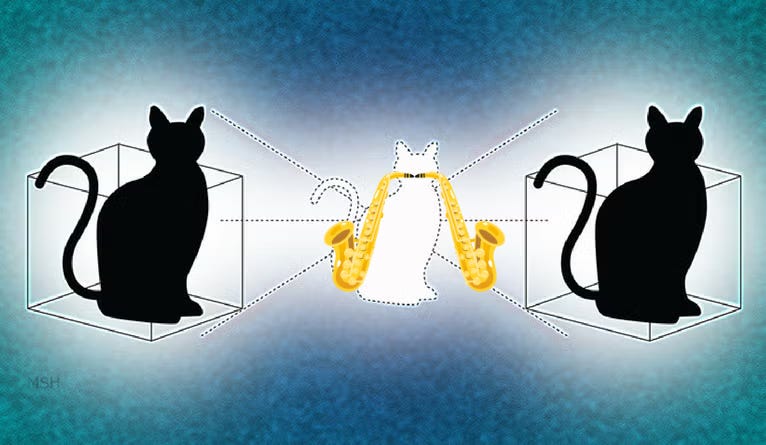
From Wikipedia:
In quantum mechanics, Schrödinger’s cat is a thought experiment concerning quantum superposition. In the thought experiment, a hypothetical cat in a closed box may be considered to be simultaneously both alive and dead while it is unobserved, as a result of its fate being linked to a random subatomic event that may or may not occur.
I’m about to draw a parallel that has nothing to do with quantum mechanics, and may indeed have little to do with the true nature of the thought experiment. I’m almost certain I’m not using this comparison correctly, but Schrodinger’s cat was the first thing I first thought of.
On a whim, I decided to post my band’s first music video onto Reddit via the subreddit, r/jazz. I posted it with a tongue-in-cheek caption; a troll, if you would. Something about what John Coltrane would’ve thought, and whether my music followed tradition.
Anyone who listens to my song, even if only for a moment, would see that my tune Jaguar clearly has little in common with the Jazz tradition. I was feeling silly that day, and was definitely trying to trick folks into listening. I feel ugly about that now, considering both the original post and the listener response to my video on that subreddit were unkind. A few people commented that they resented being tricked into listening, and that they might have liked the music if given the chance to listen with an honest pretense.
It hurt in the moment, even if it was a well-deserved response. I deleted the post, and soon after began thinking about how challenging it has been to find the right spaces to share my music. It’s certainly not jazz; that opinion has been corroborated by internet folks and real-life musicians. But it’s also not…anything else?
As a student of jazz, I have strong opinions on what distinguishes music as jazz. Very little of my works with Feralcat and the Wild would fall into even my own personal categorization of jazz music.
Our songs are through-composed. The song is structured from start to finish ahead of time, with a small, prescribed space for improvised solos. By contrast, most of what can be considered jazz music is structured more loosely, with parts of the song written and the majority of the song left open-ended for improvisation.
Our instrumentation more closely resembles a 6-piece rock or metal outfit, with guitars, synthesizers, bass and drums. The only real deviation (which isn’t actually a deviation) from a rock band is that I’ve placed myself (on saxophone) in a position normally held by a lead singer. Although there are many jazz groups with similar configurations, it’s common to see more acoustic instruments and smaller combo sizes.
Our musical language, whether in solos or in composition, draws primarily from rock & metal music. My compositional inspirations are varied, splintered into music I’ve both performed and listened to in my 20 year tenure. Jazz has it’s own distinct language from which improvisational solos and compositions are derived. I admittedly use some jazz language in both solos and writing, but I don’t think it’s enough to label the collective works as jazz.
I would grow frustrated with the publications that wrote about my work. Even professional music journalists couldn’t listen to Feralcat and the Wild without calling it jazz. It seemed inevitable that my works would never escape the jazz accusations.
Yet, the jazz world won’t touch my music with a 1000 foot pole.
I’ve sent the music, both casually and professionally, to people who I identify as jazz heroes and avid listeners of the art form. Radio silence. Then, the first time I share it with a dedicated jazz community, the people are repulsed. Claiming, exactly as I would, that Feralcat and the Wild shares nothing with the art form commonly known as jazz. That it’s damn near an insult to even consider that this “generic metal” has anything in common with the exalted Black American art form. I can’t help but agree, minus the generic part.
For what it’s worth, jazz is, historically, a racially-charged means of describing Black American Music. I give most listeners the benefit of the doubt, but given my largely non-white band, this mis-categorization has racist undertones. Historically, jazz was a derogatory means of lumping compositional innovators together by race over the radio. Regardless of popularity or deviation from Swing/Bebop, if a Black person made it, it was “jazz” or “urban” music.
Nowadays this argument is mostly irrelevant, because jazz music is exalted as high art. There are more white practitioners now than ever. They have erected barriers to entry like expensive degrees. Rarely do the contemporary greats come from circumstances akin to that of their heroes.
As an informed listener, I can distinguish the components of my compositions that detract from “jazz;” most of my listeners cannot. To my endless frustration, the mostly-white audience hears a saxophone and instinctively categorizes the music as jazz. I’ve been fighting this categorization since the beginning, begging and pleading for my work to be judged singularly. Metal with a saxophone, or perhaps my own genre of worldbuilding, heavy, progressive, soundtrack-esque music.
I’m exhausted by the inability to find a stable audience. Feralcat and the Wild is exciting enough to be loved when performed live to an unassuming (largely Pittsburgh, where I used to live) audience. Their reactions were overwhelmingly positive, but talking to listeners afterwards could be tiresome. Folks who try to tell me how much they enjoy jazz, or telling me how they used to play some beginner instrument in school. Where I personally see more comparison to the likes of Coheed and Cambria or Circa Survive (my two primary influences), these listeners seem to think I have more in common with their brief childhood band experience. It upsets me; while I hope to inspire children to pursue music beyond their forced introduction, it hurts to know that the ears I’m reaching don’t understand what they’re hearing. I’m certain that the audience at these performances has the capacity for critical listening in more popular genres. But the second they hear a saxophone, it’s jazz and nothing else matters.
So finally, we arrive at the thought experiment.
In my likely misinformed interpretation, akin to that of the audience I described for Feralcat and the Wild, I ask: is or isn’t my music jazz? Where does it exist in the great big ocean of music we’ve developed over millennia of human development? When you place my music in a theoretical box, is it both jazz and not jazz for all eternity? What subatomic event needs to occur to give us a real, quantifiable answer?
None of this truly matters, especially if folks keep listening to and enjoying the works. I’ll keep making. I’ll keep listening. I’ll keep letting folks loudly and incorrectly talk at me about what my music is. Yet another publication will nominate my recordings for “best jazz band” while the big, bad jazz police come after me with pitchfork in hand.
My music exists, yet it doesn’t. Schrodinger’s Jazz.